
Discontinued tools
Select a tool in the table to view the content
| Title | Description | Category |
|---|---|---|
| HPG Aligner | Ultrafast and highly sensitive Next-Generation Sequencing (NGS) read mapping |
High Performance Genomics for NGS data |
| HPG Pore | Toolkit for exploring and analysing nanopore sequencing data human |
High Performance Genomics for NGS data |
| ngsCAT | a tool to assess the efficiency of targeted enrichment sequencing |
High Performance Genomics for NGS data |
| VARIANT | Fast and accurate functional characterization of variants in VCF file |
Variant annotation |
| CellBase | RESTful Web Services for retrieving releant biological information |
Variant annotation |
| GenomeMaps | Our higly efficient nex generation genome viewer (used by the ICGC) |
Variant Visualization |
| BiERapp | Variant/gene prioritization tool (from VCF to candidates) |
Variant prioritization |
| TEAM | Targeted enrichment sequencing (panels) diagnostic tool |
Diagnostic |
| RENATO | Inferring the regulatory network behind a gene expression experiment |
Transcriptional networks |
| Snow | Network enrichment of a set of genes |
Network analysis |
| Network Miner | Network enrichment analysis of a ranked list of genes |
Network analysis |
| PATHiWays | Inferring the functional effect of gene expression changes in signaling pathways |
Pathway analysis |
| PATHiVar | Assessing the impact of mutations found in next generation sequencing data over human signaling pathways |
Pathway analysis |
| Babelomics | A program suite for advanced functional genomic data analysis |
Packages |
| Pupasuite | Functional characterization of SNPs |
Tools no longer supported |
| Phylemon | Evolution, phylogenetics, phylogenomics |
Tools no longer supported |
| GEPAS | Microarray data analysis |
Tools discontinued |
Snow : Network enrichment of a set of genes
SNOW: Studying Networks in the Omic World
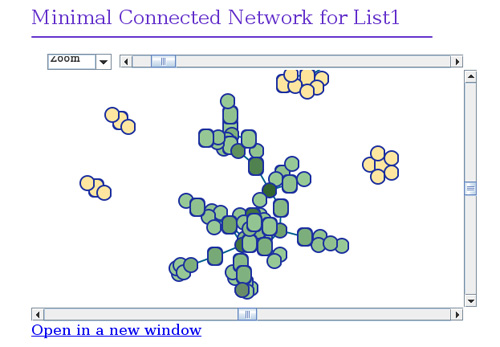
SNOW stands for "Studying Networks in the Omic World" and complements tools such as FatiGO and Marmite (Babelomics suite) introducing a new dimension in the functional profiling of high-throughput experiments results, this is, protein-protein interaction data. SNOW extracts and evaluates the cooperative behavior of lists of selected proteins/genes using the interactome as scaffold.
SNOW identifies hubs and evaluates the global degree of connections, centrality and neighborhood aggregation of the list by comparing the distributions of nodes connections degree, betweenness centrality and clustering coefficient respectively against the complete distribution of these parameters into the interactome of reference. Besides this, SNOW extracts the minimum network that connects the proteins/genes in the list. A user-fixed number of external proteins to connect nodes in the list is allowed. The topology of this network is evaluated by comparing distributions of graph parameters of this network against pre-calculated distributions of a set (10000) of random lists with same size range. By this, SNOW extracts information about whether the network represented in the list has more hubs, is more connected or has a more regular connections distribution than a random network.SNOW also provides an interactive visualization of the network and a complete description of interatomic and local network parameters of each protein/gene in the list as well as the external nodes introduced by the program. This information together with the functional annotation provided will guide the user to identify the important nodes within, or even outside, the list as well as evaluate the modular functionality of the list as an entity.
More info at: http://snow.bioinfo.cipf.es
Publication
- Minguez P, Gotz S, Montaner D, Al-Shahrour F, Dopazo J. 2009. SNOW, a web-based tool for the statistical analysis of protein-protein interaction networks. Nucl. Acids Res.; 37:W109-114