
Discontinued tools
Select a tool in the table to view the content
| Title | Description | Category |
|---|---|---|
| HPG Aligner | Ultrafast and highly sensitive Next-Generation Sequencing (NGS) read mapping |
High Performance Genomics for NGS data |
| HPG Pore | Toolkit for exploring and analysing nanopore sequencing data human |
High Performance Genomics for NGS data |
| ngsCAT | a tool to assess the efficiency of targeted enrichment sequencing |
High Performance Genomics for NGS data |
| VARIANT | Fast and accurate functional characterization of variants in VCF file |
Variant annotation |
| CellBase | RESTful Web Services for retrieving releant biological information |
Variant annotation |
| GenomeMaps | Our higly efficient nex generation genome viewer (used by the ICGC) |
Variant Visualization |
| BiERapp | Variant/gene prioritization tool (from VCF to candidates) |
Variant prioritization |
| TEAM | Targeted enrichment sequencing (panels) diagnostic tool |
Diagnostic |
| RENATO | Inferring the regulatory network behind a gene expression experiment |
Transcriptional networks |
| Snow | Network enrichment of a set of genes |
Network analysis |
| Network Miner | Network enrichment analysis of a ranked list of genes |
Network analysis |
| PATHiWays | Inferring the functional effect of gene expression changes in signaling pathways |
Pathway analysis |
| PATHiVar | Assessing the impact of mutations found in next generation sequencing data over human signaling pathways |
Pathway analysis |
| Babelomics | A program suite for advanced functional genomic data analysis |
Packages |
| Pupasuite | Functional characterization of SNPs |
Tools no longer supported |
| Phylemon | Evolution, phylogenetics, phylogenomics |
Tools no longer supported |
| GEPAS | Microarray data analysis |
Tools discontinued |
GenomeMaps : Our higly efficient nex generation genome viewer (used by the ICGC)
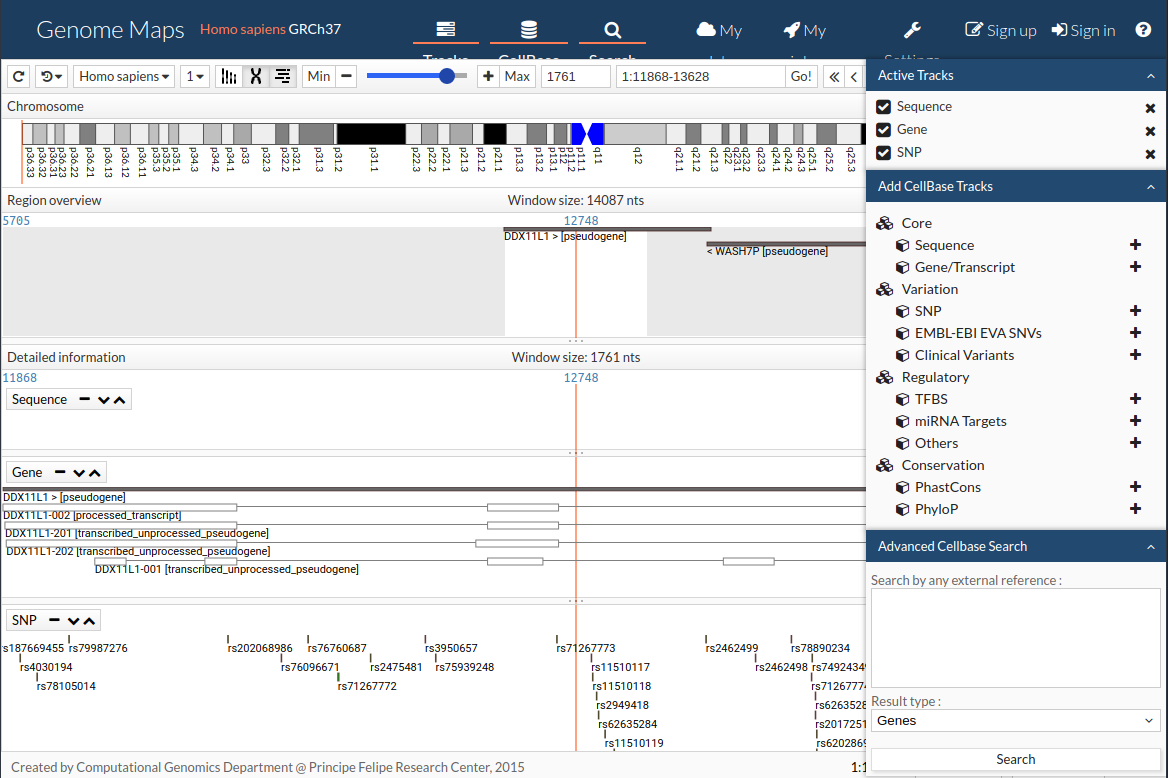
Genome Maps a new generation genome browser
Genome browsers have gained importance as more genomes and related genomic information be-come available. However, the increase of information brought about by new generation sequencing technologies is, at the same time, causing a subtle but continuous decrease in the efficiency of conventional genome browsers. Here we present Genome Maps, a genome browser that implements an innovative model of data transfer and management. The program uses highly efficient technologies from the new HTML5 standard, such as SVG, that optimize workloads at both, server, and client sides and ensure future scalability. Thus, data management and representation are entirely carried out by the browser, without the need of any Java Applet, Flash or other plug-in technology installation. Relevant biological data on genes, transcripts, exons, regulatory features, single nucleotide polymorphisms (SNPs), karyotype, etc., are imported from web services and are available as tracks. In addition, several DAS servers are already included in Genome Maps. As a novelty, this web-based genome browser allows the local upload of huge genomic data files (e.g., VCF or BAM) that can be dynamically visualized in real time at the client side, thus facilitating the management of medical data affected by privacy restrictions. Finally, Genome Maps can easily be integrated into any web application by including only a few lines of code.
Implementation
- Genome maps is the official genome viewer of the ICGC and it is implemented in its analysis portal (ICGC Data Portal)
- Genome Maps is an open source collaborative initiative available in the GitHub repository.
- Genome Maps is available at: http://www.genomemaps.org.
- Genome Maps wiki site in GitHub.
- Projects using Genome Maps technology out there:
- The Genome Browser of ICGC project (https://dcc.icgc.org/search/g)
- Lens PatSeq Explorer (http://www.lens.org/lens/bio/patseqexplorer)
- Chaetomium thermophilum genome at EMBL (http://ct.bork.embl.de/ctbrowser)
Publication
- Medina et al., NAR 2013