
Discontinued tools
Select a tool in the table to view the content
| Title | Description | Category |
|---|---|---|
| HPG Aligner | Ultrafast and highly sensitive Next-Generation Sequencing (NGS) read mapping |
High Performance Genomics for NGS data |
| HPG Pore | Toolkit for exploring and analysing nanopore sequencing data human |
High Performance Genomics for NGS data |
| ngsCAT | a tool to assess the efficiency of targeted enrichment sequencing |
High Performance Genomics for NGS data |
| VARIANT | Fast and accurate functional characterization of variants in VCF file |
Variant annotation |
| CellBase | RESTful Web Services for retrieving releant biological information |
Variant annotation |
| GenomeMaps | Our higly efficient nex generation genome viewer (used by the ICGC) |
Variant Visualization |
| BiERapp | Variant/gene prioritization tool (from VCF to candidates) |
Variant prioritization |
| TEAM | Targeted enrichment sequencing (panels) diagnostic tool |
Diagnostic |
| RENATO | Inferring the regulatory network behind a gene expression experiment |
Transcriptional networks |
| Snow | Network enrichment of a set of genes |
Network analysis |
| Network Miner | Network enrichment analysis of a ranked list of genes |
Network analysis |
| PATHiWays | Inferring the functional effect of gene expression changes in signaling pathways |
Pathway analysis |
| PATHiVar | Assessing the impact of mutations found in next generation sequencing data over human signaling pathways |
Pathway analysis |
| Babelomics | A program suite for advanced functional genomic data analysis |
Packages |
| Pupasuite | Functional characterization of SNPs |
Tools no longer supported |
| Phylemon | Evolution, phylogenetics, phylogenomics |
Tools no longer supported |
| GEPAS | Microarray data analysis |
Tools discontinued |
GEPAS : Microarray data analysis
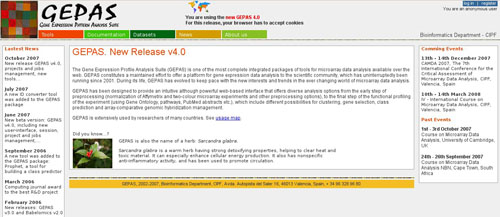
GEPAS: A web-based tool for microarray data analysis and interpretation
GEPAS was one of the most complete and extensively used web-based packages for microarray data analysis. During its more than 10 years of activity it has continuously been updated to keep pace with the state-of-the-art in the changing microarray data analysis arena. In 2013 GEPAS was discontinued and all its functionality was implemented in Babelomics.
GEPAS offered diverse analysis options that included well established as well as novel algorithms for normalization, gene selection, class prediction, clustering and functional profiling of the experiment. New options for time-course (or dose-response) experiments, microarray-based class prediction, new clustering methods and new tests for differential expression wer included in subsequent versions.
An extensive re-engineering of GEPAS was carried out which included the use of web services and Web 2.0 technology features, a new user interface with persistent sessions and a new extended database of gene identifiers. GEPAS has been the most quoted web tool in its field and it has been extensively used by researchers of many countries. GEPAS statistics indicate an average usage rate of 500 experiments per day.
All the functionality of GEPAS, is now available within Babelomics http://www.babelomics.org.