
Discontinued tools
Select a tool in the table to view the content
| Title | Description | Category |
|---|---|---|
| HPG Aligner | Ultrafast and highly sensitive Next-Generation Sequencing (NGS) read mapping |
High Performance Genomics for NGS data |
| HPG Pore | Toolkit for exploring and analysing nanopore sequencing data human |
High Performance Genomics for NGS data |
| ngsCAT | a tool to assess the efficiency of targeted enrichment sequencing |
High Performance Genomics for NGS data |
| VARIANT | Fast and accurate functional characterization of variants in VCF file |
Variant annotation |
| CellBase | RESTful Web Services for retrieving releant biological information |
Variant annotation |
| GenomeMaps | Our higly efficient nex generation genome viewer (used by the ICGC) |
Variant Visualization |
| BiERapp | Variant/gene prioritization tool (from VCF to candidates) |
Variant prioritization |
| TEAM | Targeted enrichment sequencing (panels) diagnostic tool |
Diagnostic |
| RENATO | Inferring the regulatory network behind a gene expression experiment |
Transcriptional networks |
| Snow | Network enrichment of a set of genes |
Network analysis |
| Network Miner | Network enrichment analysis of a ranked list of genes |
Network analysis |
| PATHiWays | Inferring the functional effect of gene expression changes in signaling pathways |
Pathway analysis |
| PATHiVar | Assessing the impact of mutations found in next generation sequencing data over human signaling pathways |
Pathway analysis |
| Babelomics | A program suite for advanced functional genomic data analysis |
Packages |
| Pupasuite | Functional characterization of SNPs |
Tools no longer supported |
| Phylemon | Evolution, phylogenetics, phylogenomics |
Tools no longer supported |
| GEPAS | Microarray data analysis |
Tools discontinued |
DBAli : Pairwise and multiple protein structure alignments
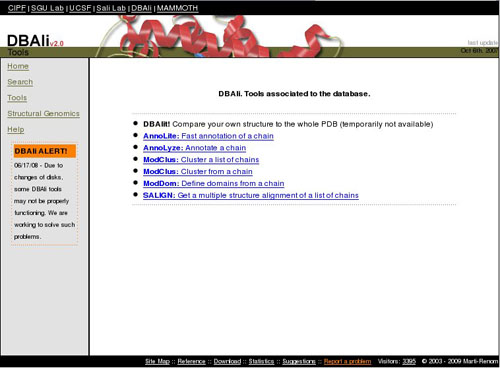
Advances in structural biology have resulted in a rapid increase in the number of experimentally determined protein structures. There is a need for an up-to-date comprehensive database of pairwise and multiple structure-based alignments for families of related proteins as well as tools to automatically and comprehensively generate, store, and analyze these alignments. We aim to provide some of this functionality to the biological community.
DBAli stores pairwise comparisons of all structures in the Protein Data Bank calculated using the program MAMMOTH. It also contains multiple structure alignments generated by the SALIGN command of MODELLER. DBAli is updated weekly. As of August 2007, DBAli contains ~1.7 billion pairwise comparisons and over 12,500 family-based multiple structure alignments for ~35,000 non-redundant protein chains in the PDB.
DBAli, a database of pairwise and multiple structure alignments, also integrates tools for dynamically establishing relationships between protein structures and their fragments. The utility of the database is illustrated by outlining several of its current applications. The DBAli database is accessible via the World Wide Web at http://www.dbali.org