
Pasar al contenido principal
Inicio

Navegación principal

  • El área
    • Inicio
    • Bioinformática traslacional
    • Systems Medicine
    • Computational Biology Unit
    • Ofertas de trabajo
    • Our Team
    • INB Functional Genomics
    • Ciberer
    • Location
  • Publicaciones
  • Proyectos
    • Nuestros proyectos
    • COVID Circuit
    • iRWD
    • Scourge
    • CSyF SARS-CoV-2 Seguimiento Andalucía
    • Covid-19 Drug Repurposing
    • Pilot WES Lung Cancer
    • HoliRD
    • Pan(AI)Rep
    • Disease Maps
    • Mlfpm
    • Undiagnosed Rare Diseases Programme (ENoD)
    • Proyecto Genoma 1000 Navarra (NAGEN 1000)
    • Sponsors
  • Utilidades
    • Our tools
    • Hipathia
    • Cov-hipathia
    • Csvs
    • SPACNACS
    • SMAca
    • Tftea
    • Metabolizer
    • Mignon
    • Collaborations
    • Discontinued tools
  • Recursos
    • Resources overview
    • Surveillance circuit
    • Siega
    • Cov-hipathia
    • Csvs
  • Eventos
    • Resumen de eventos
    • Difusión de eventos
    • Jabi 2023
    • CAMDA
    • Jabi 2024
  • Courses
    • Cursos
    • Our Courses
  • Novedades
  • Colaboradores
Menú de cuenta de usuario
  • Iniciar sesión

Ruta de navegación

  1. Inicio
  2. Collaborations
  3. PTMCode

Collaborations

Select a tool in the table to view the content

Title Description
PTMCode

The database of post-translational modifications within and between proteins
SNPeffect

on-line prediction of effects of protein-coding variants

DBAli

Pairwise and multiple protein structure alignments

SARA

Functional annotation of RNA structures

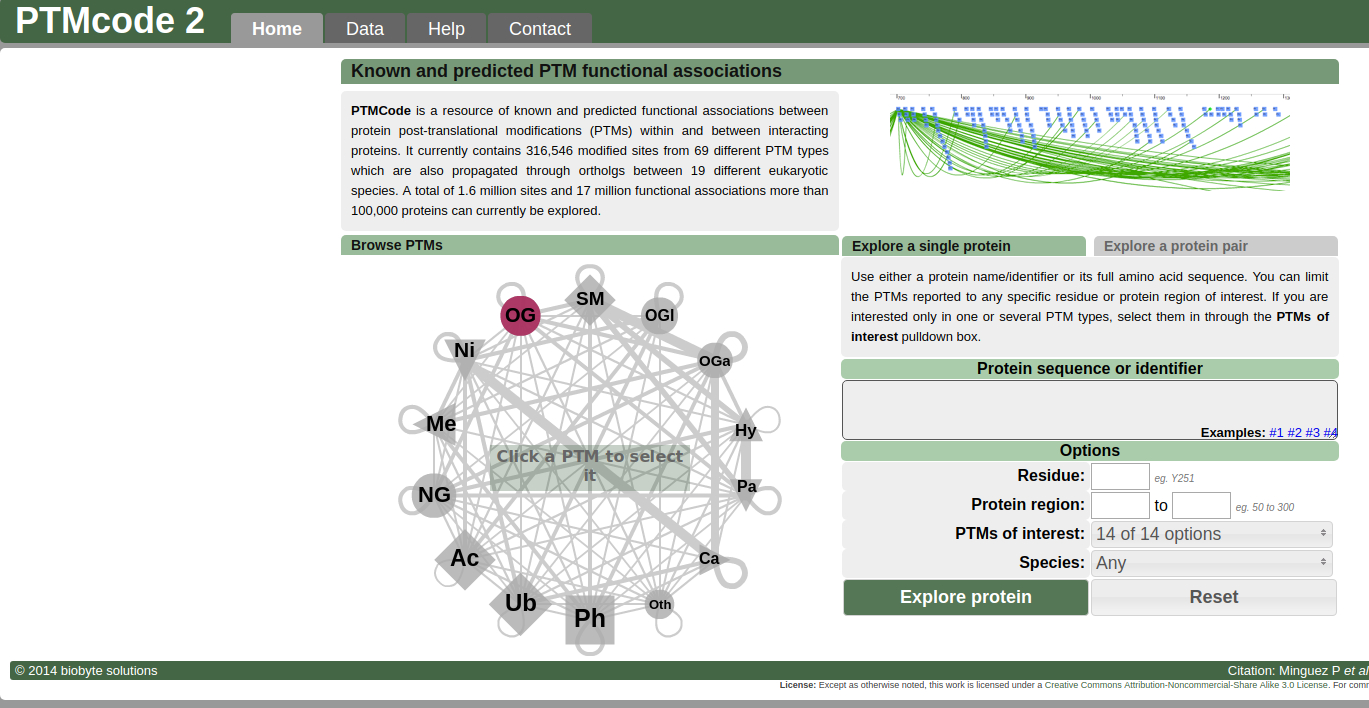
PTMCode : The database of post-translational modifications within and between proteins

PTMcode

PTMcode v2: a resource for functional associations of post-translational modifications within and between proteins.

The post-translational regulation of proteins is mainly driven by two molecular events, their modification by several types of moieties and their interaction with other proteins. These two processes are interdependent and together are responsible for the function of the protein in a particular cell state. Several databases focus on the prediction and compilation of protein-protein interactions (PPIs) and no less on the collection and analysis of protein post-translational modifications (PTMs), however, there are no resources that concentrate on describing the regulatory role of PTMs in PPIs. We developed several methods based on residue co-evolution and proximity to predict the functional associations of pairs of PTMs that we apply to modifications in the same protein and between two interacting proteins. In order to make data available for understudied organisms, PTMcode v2 (http://ptmcode.embl.de) includes a new strategy to propagate PTMs from validated modified sites through orthologous proteins. The second release of PTMcode covers 19 eukaryotic species from which we collected more than 300 000 experimentally verified PTMs (>1 300 000 propagated) of 69 types extracting the post-translational regulation of >100 000 proteins and >100 000 interactions. In total, we report 8 million associations of PTMs regulating single proteins and over 9.4 million interplays tuning PPIs.

  • Implementation

  • PTMCode 2 is available at: http://ptmcode.embl.de/


  • Publication

  •  Minguez P, Letunic I, Parca L, Garcia-Alonso L, Dopazo J, Huerta-Cepas J, Bork P. 2014. PTMcode v2: a resource for functional associations of post-translational modifications within and between proteins. 43:D494-D502
Subir ⬆
image chatbot Pregunta al Chatbot
Logo junta de andalucía blanco

Copyright © Andalusian Platform for Computational Medicine - 2017/2023, FPS 

The ultimate objective of the Area is to bring to the clinician complex algorithms for the management of complex genomics data in a transparent way for them, which ultimately foster the adoption of innovative technologies in the current clinical practice.

Menu

  • Inicio
  • Herramientas
  • Publicaciones
  • Contacto
  • Ubicación
  • Acceso

Síguenos

  • Youtube
  • X
  • Política de privacidad