
Home

Navegación principal

  • The Area
    • Home
    • Translational Bioinformatics
    • Systems Medicine
    • Computational Biology Unit
    • Job Offers
    • Our Team
    • INB Functional Genomics
    • Ciberer
    • Location
  • Publications
  • Projects
    • Our Projects
    • COVID Circuit
    • iRWD
    • Scourge
    • CSyF SARS-CoV-2 Seguimiento Andalucía
    • Covid-19 Drug Repurposing
    • Pilot WES Lung Cancer
    • HoliRD
    • Pan(AI)Rep
    • Disease Maps
    • Mlfpm
    • Undiagnosed Rare Diseases Programme (ENoD)
    • Proyecto Genoma 1000 Navarra (NAGEN 1000)
    • Medical Genome Project
    • Sponsors
  • Tools
    • Our tools
    • Hipathia
    • Cov-hipathia
    • Csvs
    • SPACNACS
    • SMAca
    • Tftea
    • Metabolizer
    • Mignon
    • Collaborations
    • Discontinued tools
  • Resources
    • Resources overview
    • Surveillance circuit
    • Siega
    • Cov-hipathia
    • Csvs
  • Events
    • Events overview
    • Outreach
    • Jabi 2023
    • CAMDA
    • Jabi 2024
  • Courses
    • About
    • Our Courses
  • News
  • Partners
Menú de cuenta de usuario
  • Log in

Breadcrumb

  1. Home
  2. Pipelines
  3. Pipeline Structural Variants

Pipeline Structural Variants

This page describes the process followed for the determination and analysis of SVs for germ or somatic samples. It is specially adapted for illumina paired-end sequencing, both of exomes and of complete genomes.
This pipeline is based on GRIDSS1 best practices:
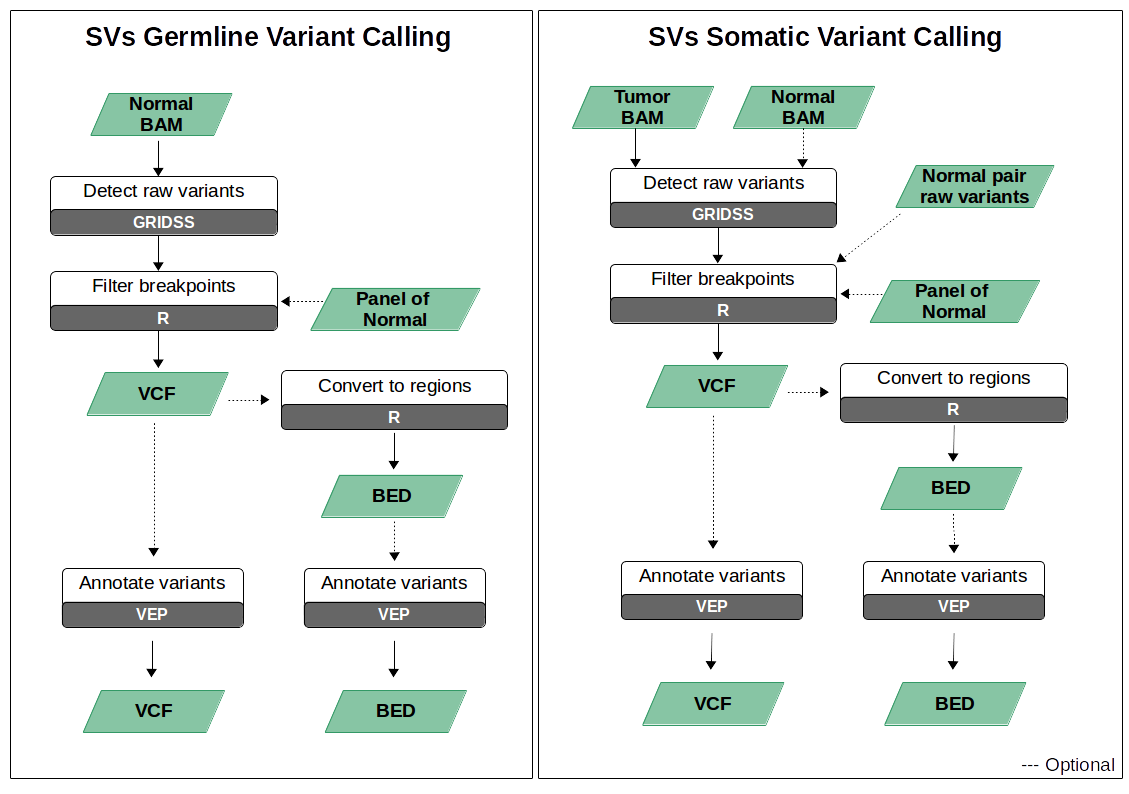
sv workflow
  • General Pipeline Structure

The pipeline has been developed using the WDL workflow development language. The implemented WDL code is specifically prepared to be executed by using the Cromwell tool. To facilitate execution, the pipeline has been encapsulated within a bash script that automates each of the steps. The complete pipeline is represented in the following diagram:
Diagram available in: sv_workflow_diagram.odp

  • Requirements and recommendations

 - This pipeline is specifically developed for illumina paired-end sequencing, although it could work with other technologies.

 - To filter raw variants, it is recommendable to create a panel of normal (PoN). It is recommended that the PoN be formed with at  least 30 independent samples sequenced under the same conditions as the test sample.

 - It is recommended to use BAMs with duplicate reads marked or, in the case of PCR-free, unmarked.

 - It is recommended not to eliminate BAM reads (duplicates, low quality by alignment, etc.)

 - It is not advisable to call on regions with low mapping, segmental duplication or high GC content.

[1] Cameron DL, Schröder J, Penington JS, Do H, Molania R, Dobrovic A, Speed TP, Papenfuss AT. GRIDSS: sensitive and specific genomic rearrangement detection using positional de Bruijn graph assembly. Genome Research, 2017 Dec;27(12):2050-2060. https://github.com/PapenfussLab/GRIDSS

image chatbot Ask the Chatbot
Logo junta de andalucía blanco

Copyright © Andalusian Platform for Computational Medicine - 2017/2023, FPS 

The ultimate objective of the Area is to bring to the clinician complex algorithms for the management of complex genomics data in a transparent way for them, which ultimately foster the adoption of innovative technologies in the current clinical practice.

Menu

  • Home
  • Tools
  • Publications
  • Contact
  • Location
  • Acceso

Follow us

  • Youtube
  • X
  • Privacy policy